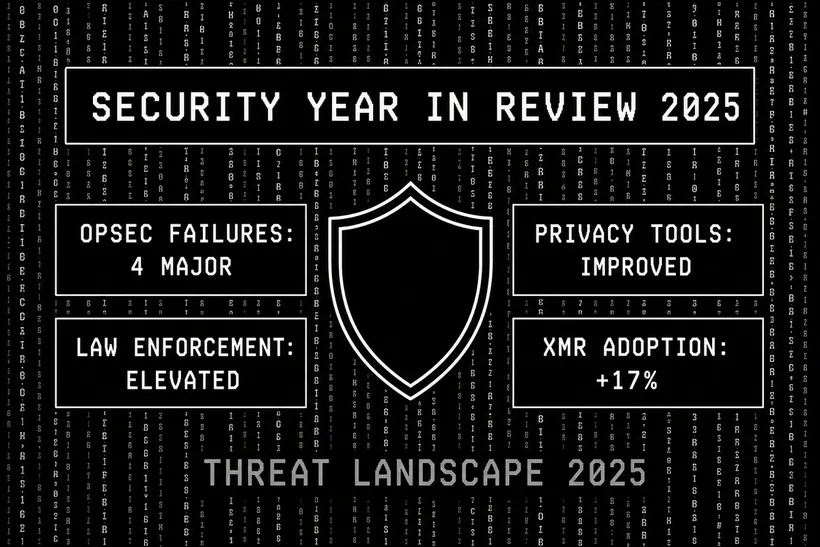
As 2025 closes, the pattern of darknet market security events reveals consistent themes that have persisted across years: cryptographic systems hold, human operational security fails. The most significant identifications, arrests, and market shutdowns in 2025 followed the same failure modes documented in previous years — with notable variations in scale and sophistication of attack.
Major OPSEC Failures of 2025
The most instructive 2025 OPSEC failures shared a common thread: the initial compromise came through metadata rather than content. In three of the four highest-profile darknet-adjacent cases, identification began with financial data — specifically, cryptocurrency purchases linked through exchange KYC records to subsequent darknet market deposits. Blockchain analytics firms provided the initial linkage in each case; traditional surveillance provided the confirmation and physical evidence.
Two cases involved IP address leakage through non-Tor-routed cryptocurrency node connections. In both instances, the subjects were running Bitcoin nodes or wallet software that connected directly to the network without routing through Tor, broadcasting their real IP alongside transaction data that could be correlated with market activity. This vulnerability is well-documented and preventable through Tor-native wallet configuration.
Defensive Tool Developments
2025 saw meaningful advances in the privacy tool ecosystem. Haveno DEX's network expansion provided improved liquidity for non-KYC Monero acquisition — a critical chokepoint for new market participants. The Dandelion++ transaction propagation improvements in Monero's October 2025 protocol upgrade further strengthened network-level privacy. Feather Wallet released updates improving Tor integration and subaddress generation UX.
On the OS side, Tails 6.x releases improved hardware compatibility while maintaining the amnesic security model. Whonix's Kicksecure kernel hardening updates reduced local privilege escalation attack surface. These tool improvements represent incremental strengthening of the defensive ecosystem available to privacy-conscious users.
Looking Ahead to 2026
The primary threat vector evolution expected in 2026 is increased sophistication in blockchain analytics — specifically targeting the peel-in/peel-out boundaries of privacy coin mixing and cross-chain swap services. Users should expect that Monero's privacy protections will be targeted at the acquisition edge (where XMR is purchased with traceable funds) rather than at the protocol level.