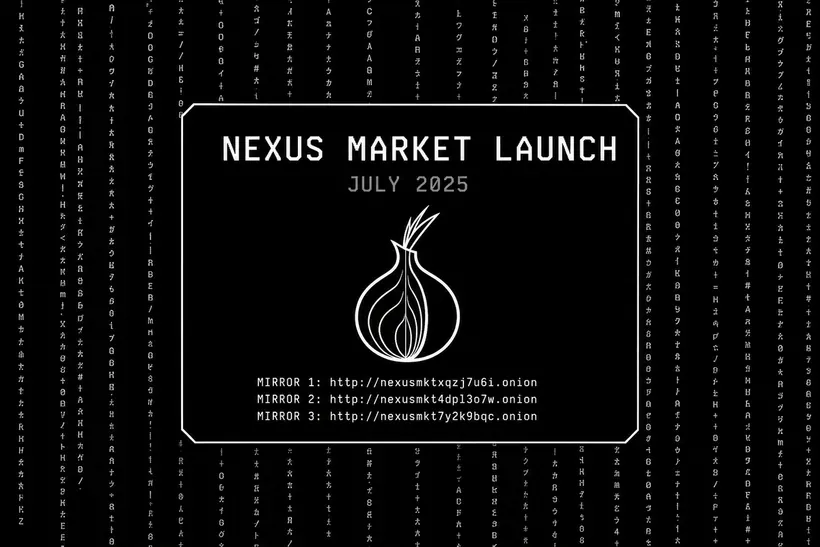
The Nexus Darknet marketplace entered the Tor hidden service ecosystem in mid-July 2025, presenting itself as a security-focused successor to markets that had recently exited through law enforcement actions or exit scams. Its debut attracted significant attention from monitoring communities due to several architectural decisions that departed meaningfully from established market conventions.
Platform Architecture at Launch
Nexus launched with three simultaneous V3 onion mirror addresses — a redundancy configuration typically seen only in more mature platforms. The technical decision to deploy three mirrors from day one signals preparedness for distributed denial-of-service pressure, which has historically targeted new platforms shortly after high-visibility launches attract user migration from defunct markets.
The registration process confirmed a no-email model: account creation requires only a username and passphrase, with an optional PGP key upload at registration. Subsequent mandatory PGP setup was enforced before the first order could be placed — an unusual but security-positive requirement that reduces plaintext order data.
Initial Feature Set
The version 1.0 feature set included: multi-signature escrow, PGP challenge-response 2FA, vendor bond system, a search and filter interface, and a basic dispute resolution queue. The platform launched without a mobile-optimized interface — a deliberate decision that reduced JavaScript dependency and improved compatibility with Tor Browser at the Safest security setting.
Monero was designated the primary payment currency from launch, with Bitcoin and Litecoin supported at higher fee tiers. This represented a philosophical alignment with privacy-native cryptocurrency rather than the broader user accessibility of BTC-first platforms.
Security Model Overview
The published security model addressed four threat classes: network interception, server compromise, social engineering, and payment tracing. Network interception is mitigated by Tor's circuit routing and the V3 onion address authentication. Server compromise is partially mitigated by PGP encryption of all order-sensitive data — the server stores encrypted blobs rather than plaintext shipping addresses.
Social engineering protection relies on platform-level PGP verification: only announcements signed by the admin keypair are considered authentic. Users are instructed to import the admin public key and verify all address announcements before updating bookmarks.
Market Context
The July 2025 launch occurred during a period of relative market consolidation following the closure of several major platforms earlier in the year. This created an established user base actively seeking new primary platforms. Nexus's initial vendor onboarding offered reduced bond requirements for verifiable established vendors migrating from closed markets — a strategy that accelerated early liquidity.
Early monitoring data from independent uptime trackers confirmed consistent availability across all three mirrors within the first weeks of operation, with a reported 97% uptime rate across the initial 30-day monitoring window.