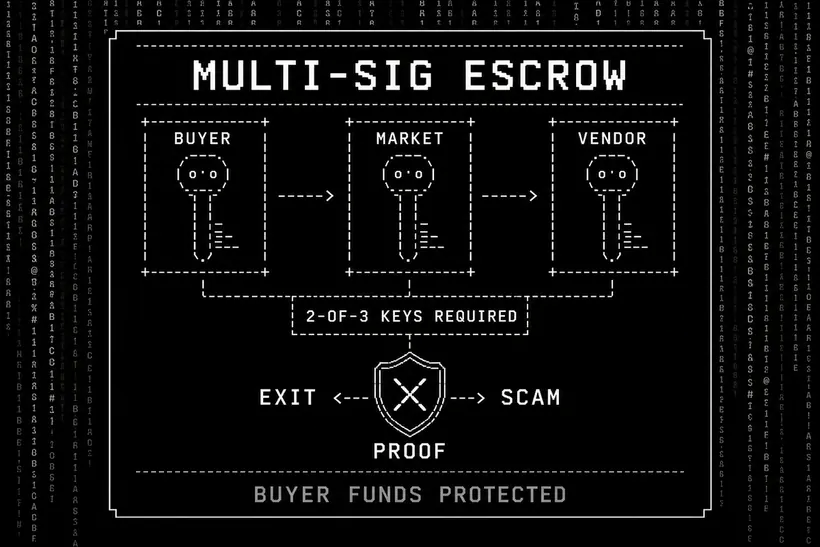
Multi-signature escrow represents the most significant structural improvement in darknet market trust architecture over the past several years. By distributing transaction signing authority across multiple parties, it eliminates the single point of failure that made traditional centralized escrow systems vulnerable to exit scams.
How Traditional Escrow Works and Why It Fails
In traditional centralized escrow, the buyer deposits funds to a wallet address controlled entirely by the market platform. The funds remain in the platform's custody until the buyer finalizes the order. This creates a single point of failure: if the platform administrators decide to exit with user funds, they hold complete signing authority over all escrowed balances. There is no technical mechanism preventing this action — only the platform's reputation and self-interest.
Exit scams have claimed hundreds of millions of dollars across documented darknet market history. Every major exit scam exploited exactly this centralized custody model. AlphaBay, Evolution, Exit scam events — all relied on the same fundamental vulnerability.
How 2-of-3 Multisig Works
In a 2-of-3 multisig arrangement, three cryptographic keys are generated: one held by the buyer, one by the vendor, and one by the market platform. The escrowed funds can only be moved with any two of the three keys — buyer+vendor, buyer+platform, or vendor+platform. No single party can unilaterally move the funds.
Normal order finalization: buyer finalizes → buyer signs + vendor signs → funds transfer to vendor. This path requires no platform involvement. Dispute finalization: buyer disputes → platform moderator reviews → moderator signs with platform key + one of buyer/vendor → funds transfer to the winning party. Exit scam scenario: platform disappears → buyer and vendor hold two of three keys → buyer and vendor can jointly sign to return funds to buyer without platform involvement.
Requirements for Buyers
Multisig requires buyers to manage a cryptographic key pair — the buyer's private key must be held securely and backed up. If the buyer loses their private key during an active multisig escrow dispute, they may be unable to cooperate in recovering funds. Monero's multisig implementation requires additional protocol steps compared to Bitcoin — market platforms supporting XMR multisig have built coordination tools into the order flow to manage this complexity.