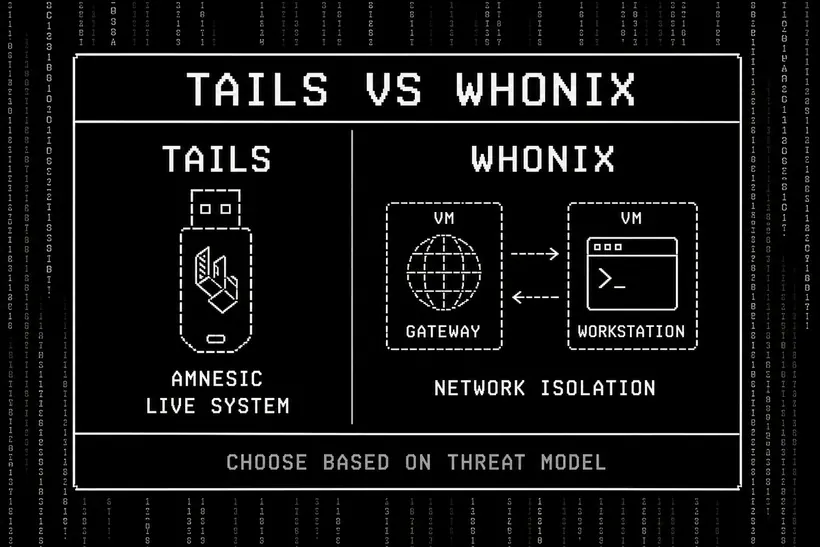
Both Tails and Whonix are legitimate, actively maintained privacy operating systems recommended for anonymous darknet use. The choice between them depends on your threat model, hardware situation, and operational requirements. Neither is universally superior — they address different aspects of the privacy problem.
Tails OS: Amnesic Live System
Tails is a live operating system installed on a USB drive and booted directly on bare hardware. It leaves no trace on the host machine — everything runs in RAM and is wiped completely on shutdown. All network connections route through Tor automatically, including those from applications other than Tor Browser.
Tails's primary security advantage is amnesia: session isolation is guaranteed by the fact that the underlying storage medium (RAM) is erased. Even if an adversary gains physical access to the machine after use, no session data is recoverable. Persistent storage is available for keys and wallets but must be explicitly enabled and encrypted.
Limitations: Tails requires physical hardware that can boot from USB. Its security model assumes the hardware firmware is not compromised — sophisticated attackers with physical access can persist through firmware. The attack surface is the Tails OS itself plus any installed applications.
Whonix: VM-Based Isolation
Whonix uses two virtual machines: a Gateway VM that routes all traffic through Tor, and a Workstation VM with no direct internet access. The Workstation's only network path is through the Gateway — even if the Workstation is compromised by malware, the real IP cannot be leaked because the Workstation physically cannot route traffic except through the Gateway's Tor circuits.
Whonix's primary advantage is network-level isolation that persists regardless of application compromise. A browser exploit that achieves code execution in the Workstation still cannot learn the real IP. Whonix also benefits from Debian's package ecosystem and can run on any hardware capable of running VirtualBox or KVM.
Limitations: Whonix runs on the host OS, meaning a compromised host (through firmware, hardware, or OS vulnerabilities) can potentially compromise both VMs. Session data persists to disk unless explicitly managed — Whonix is not inherently amnesic.
Which to Choose
Choose Tails if: you need amnesia (forensic resistance), you share a physical machine, you operate in high-risk environments where physical device seizure is a credible threat, or you want the simplest security-by-default setup. Choose Whonix if: you need to persist data between sessions (keys, wallets, notes), you require software not available on Tails, or you operate on hardware where USB booting is problematic. The ideal setup for sophisticated users is Whonix running within Tails — combining both systems' protections.