The practical privacy difference between Bitcoin and Monero for darknet market use is not a matter of preference — it is a measurable technical gap with documented real-world consequences. This analysis compares the two currencies across the dimensions that matter most for users seeking transaction privacy.
Bitcoin's Privacy Model: Pseudonymous, Not Anonymous
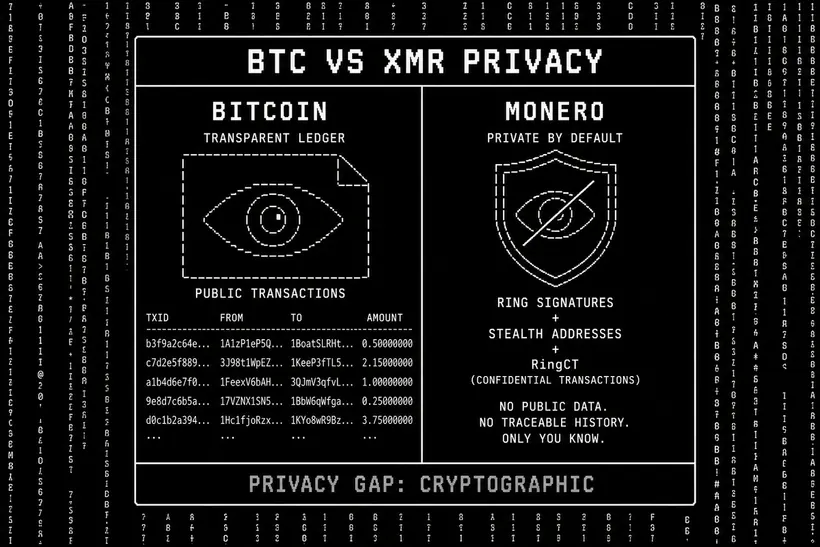
Bitcoin addresses are not inherently linked to identities, but every transaction is permanently recorded on a public ledger. The sender's address, recipient's address, and transferred amount are visible to anyone using a block explorer. Bitcoin offers pseudonymity — you are not automatically identified, but all your transactions are traceable once any link to your identity is established.
Chain analysis firms exploit this transparency through clustering algorithms that group addresses belonging to the same wallet, common-input-ownership heuristics that link transaction inputs, and exchange data correlation that connects on-chain activity to KYC records. These techniques have documented success rates in darknet-related investigations and are commercially available to law enforcement in multiple jurisdictions.
Monero's Privacy Model: Cryptographically Enforced
Monero addresses the Bitcoin privacy gap at the protocol level using three complementary mechanisms. Ring signatures bundle each transaction input with 15 decoy inputs from other historical outputs — making the actual sender cryptographically indistinguishable from the group. Stealth addresses generate a unique one-time address for every incoming transaction, preventing linkage between receives on the public ledger. RingCT hides all transaction amounts using Pedersen commitments, making amount-based heuristics impossible.
These protections are not optional — every Monero transaction uses all three mechanisms regardless of user configuration. There is no non-private XMR transaction, which is the fundamental difference from optional Bitcoin privacy tools.
Practical Implications for Market Users
A user who deposits Bitcoin to a darknet market creates a public on-chain record: funds moved from address A to address B (market deposit address). If address A is ever linked to their identity — through exchange KYC, IP observation at their node, or any other means — the market deposit becomes part of their documented transaction history. This linkage can occur years after the original transaction.
A user who deposits Monero creates no equivalent public record. The deposit transaction is visible on the Monero blockchain but the sender, recipient, and amount are protected by ring signatures, stealth addresses, and RingCT respectively. No chain analysis firm has published documented success tracing properly conducted XMR transactions.